
| Things to do in Narbonne | What you'll discover | Distance from the Place de l'Hôtel-de-Ville |
|---|---|---|
| Narbo Via | The museum of Roman Narbonne | 1.3 km |
| Via Domitia | The Roman road at the heart of the square | On the square |
| Horreum | Underground Roman galleries | 200 m |
| Archbishops' Palace | The museum and the view from the keep | On the square |
| Saint-Just Cathedral | The Gothic choir and the Treasury | 100 m |
| Saint-Paul Basilica | The crypt and the frog in the holy water stoup | 460 m |
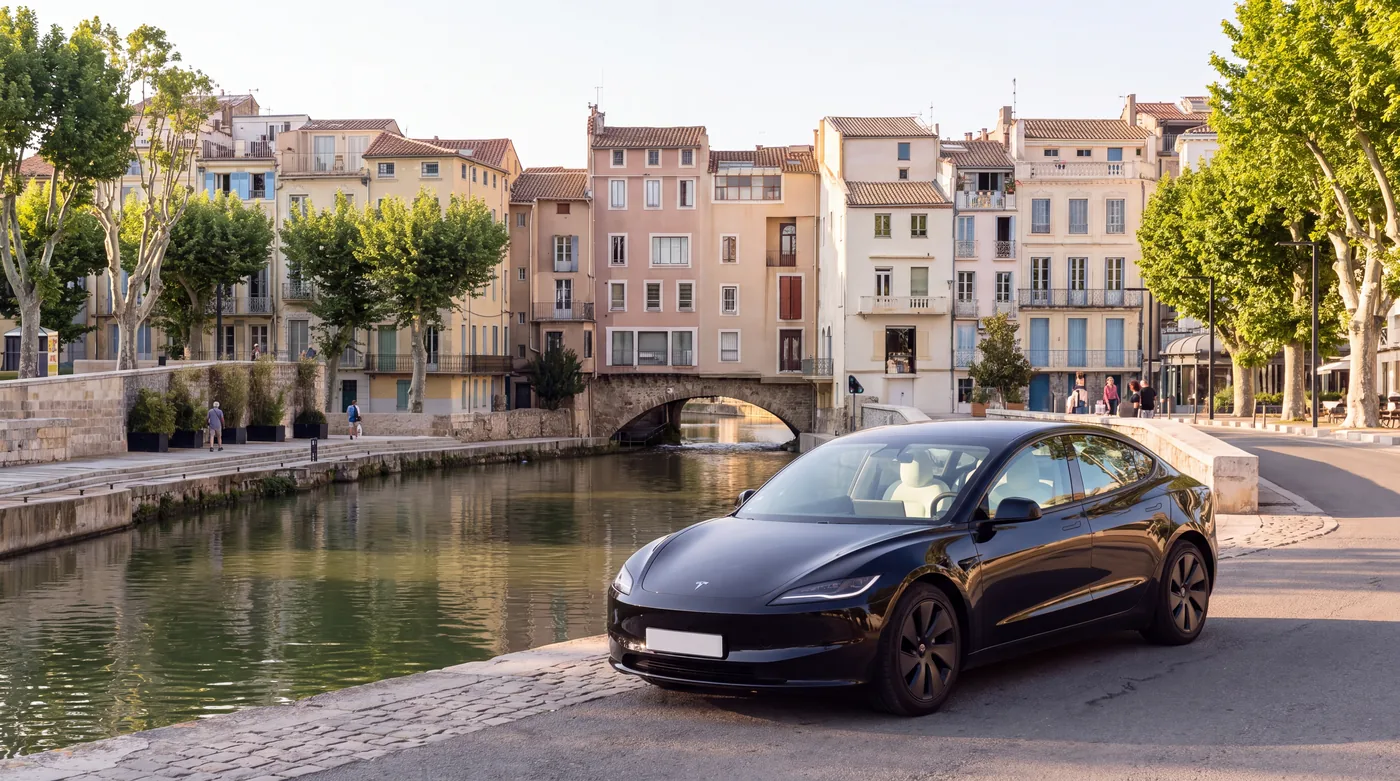
| Canal de la Robine | The banks and the Pont des Marchands | 170 m |
| Les Halles | The covered market and its food counters | 330 m |
| Narbonne-Plage | The seaside resort and its seafront | 16 km |
| Massif de la Clape | Hiking and the Gouffre de l'Œil Doux | 11 km |
| Gruissan | The circular village and the chalets | 14 km |
| Abbaye de Fontfroide | The Cistercian abbey and its gardens | 15 km |
The must-sees of Narbonne's historic centre
Narbonne's historic town centre can be explored on foot: its Roman and medieval heritage adds up to six visits within a few hundred metres of the Place de l'Hôtel-de-Ville, the town hall square, with the exception of Narbo Via, beside the canal.
Narbo Via, the museum of Roman Narbonne
Narbo Via tells the story of Narbo Martius, founded in 118 BC and described by the museum as the first Roman colony outside Italy. Opened in 2021 and designed by the architects Foster + Partners, the single-storey building takes you through 950 works and objects.
- The lapidary wall: 760 carved Roman blocks, arranged over a length of 76 m and a height of 10 m.
- A large mosaic of Bacchus and wall paintings from the ancient Clos de la Lombarde district.
- Fragments of the Capitol, which the museum describes as the largest temple in Gaul.
Full details of the displays are on the official Narbo Via website (in French).
The Via Domitia, in the middle of the square
In the centre of the Place de l'Hôtel-de-Ville, a section of the Via Domitia can be seen below street level: this is the Roman road that linked Italy to Spain in the 2nd century BC. Discovered in 1997 and then restored, it shows the ancient paving stones, and children love playing on it.
The Horreum, Roman galleries beneath the town
Lying 5 metres below today's ground level, the Horreum is a network of galleries built in the 1st century BC, which served as the foundations of a building south of the forum. Listed as a historic monument in 1961 and opened to the public in 1976, it is one of the few Roman monuments you can visit in the centre of Narbonne.
The Archbishops' Palace and the Gilles Aycelin keep
The Archbishops' Palace (Palais des Archevêques), both a residence and a fortress, now houses the town hall and the Palais-Musée des Archevêques, the palace museum. Its façade was remodelled by Viollet-le-Duc to house the town hall from 1845.
- The Gilles Aycelin keep, built between 1290 and 1311, rises to 41 metres: its terrace offers views over the town, the coast and the Corbières, as far as the Pyrenees.
- The Passage de l'Ancre separates the Palais Neuf (New Palace) from the Palais Vieux (Old Palace) and leads to the cloister.
- The museum's art trail, the Parcours d'art, covers the arts from the 15th to the 20th century.
Visitor information for the keep is on the Narbonne town council page (in French).
Saint-Just-et-Saint-Pasteur Cathedral
Built between 1272 and 1340, the cathedral was never finished: only the choir was built, because the consuls refused to demolish the town walls to extend it. Its vaults rise to more than 40 metres. Upstairs, the Treasury room has surprising acoustics, with sound travelling from one corner of the room to the other, and its collection includes a Flemish tapestry of the Creation dated 1500.
Saint-Paul Basilica
Built over the tomb of Paul, the first bishop of Narbonne, Saint-Paul is the town's first Gothic church. Inside are the crypt, a former cemetery from the 3rd and 4th centuries, a Romanesque capital of the Last Judgement and the holy water stoup with the frog, a frog carved in white marble.
A stroll along the Canal de la Robine
The Canal de la Robine (the Robine canal) runs through the historic centre and lends itself to a walk or a bike ride, under the plane trees of the Cours Mirabeau and the Promenade des Barques. At 32 km long, it links the Canal du Midi to the Mediterranean at Port-la-Nouvelle, and it has been on the UNESCO World Heritage List, along with the Canal du Midi, since 1996.
- The Pont des Marchands, one of the last bridges in France still lined with houses, with arches dating from Roman times.
- Electric boat hire and guided barge trips.
- The towpath, which continues across the lagoons to Port-la-Nouvelle.
The canal follows the former bed of the river Aude, diverted by a flood in the late 14th century. Its name comes from the Occitan word “roubine”, meaning canal.
A taste of Narbonne at Les Halles
Les Halles de Narbonne is the town's covered market, a Baltard-style steel and glass structure open since 1 January 1901, beside the Canal de la Robine. In June 2022, it was voted the most beautiful market in France in the competition run by the French TV channel TF1.
Around sixty traders run butcher's, charcuterie, fishmonger's, greengrocer's, delicatessen and wine stalls, along with bars and counters where you can eat on the spot. According to the tourist office, the atmosphere is liveliest on Sunday mornings and at aperitif time.
Around Narbonne: the beach, La Clape, Gruissan and Fontfroide
Less than 20 km from the centre, Narbonne's scenery changes: the sea, the garrigue scrubland, a fishing village and an abbey in the Corbières.
Narbonne-Plage
Narbonne's seaside resort, 16 km away by road, has nearly 5 km of fine sandy beach, with lifeguards in season, at the foot of the Massif de la Clape. It has held the Blue Flag since 1988.
- A 2.5 km pedestrian promenade along the seafront.
- A marina and water sports: sand yachting, kitesurfing, jet skiing.
- The Exals botanical and geological trail, about 3 km long, at the foot of La Clape.
The Massif de la Clape and the Gouffre de l'Œil Doux
The Massif de la Clape is a former island of 15,000 hectares between Narbonne and the sea, a protected site since 1973. You can hike, mountain bike or ride on horseback through the garrigue and the pine woods, with views of the Pyrenees and the Mediterranean, among the vineyards of the AOC La Clape wine appellation.
The Gouffre de l'Œil Doux, in the municipality of Fleury near Saint-Pierre-la-Mer, is a collapsed cave that the tourist office describes as one of only two cenotes in Europe. You reach it on foot, and swimming is not allowed. On days of high fire risk, access to the massifs may be closed: check before you set off.
Gruissan
Gruissan, 14 km from Narbonne, is a circular village built around a rock crowned by the Tour Barberousse, a tower built between 1245 and 1247. Its narrow streets wind around the tower, between the lagoons and the sea.
- The Plage des Chalets and its 1,330 chalets on stilts, where Jean-Jacques Beineix filmed “37°2 le matin” (Betty Blue) in 1985.
- The Ayguades, Mateille and Grazel beaches.
- The Île Saint-Martin saltworks.
The Abbaye de Fontfroide
Lying 15 km south-west of Narbonne, in a small valley in the Corbières, the Abbaye de Fontfroide (Fontfroide Abbey) was founded in 1093 near a spring, the Fons Frigidus, which gave it its name. Restored from 1908 onwards by the collector Gustave Fayet, it is open to visitors, with its church, its cloister and more than 8 hectares of gardens.
According to the abbey's official website (in French), a bus links it to Narbonne only in July and August: the rest of the year, there is no public transport to the abbey.
Narbonne in a day: the itinerary
One day is enough to see the main sights of Narbonne, keeping the late afternoon for the sea.
- In the morning, the Place de l'Hôtel-de-Ville: the ancient remains of the Via Domitia, then the Archbishops' Palace and the climb up the keep.
- Saint-Just Cathedral and its Treasury, a stone's throw away, then the Horreum.
- Lunch at Les Halles, beside the canal.
- In the afternoon, a walk along the Canal de la Robine to Narbo Via.
- At the end of the day, Narbonne-Plage or the village of Gruissan.
If you are staying longer, keep one day for Fontfroide and La Clape, and another for the villages of the Corbières such as Lagrasse, 43 km away, or for the medieval Cité de Carcassonne, 60 km away.
Visiting Narbonne and the surrounding area without a car
The centre of Narbonne can be explored on foot, but the beach, La Clape, Gruissan and Fontfroide require a vehicle, especially out of season. With a VTC (a licensed private hire vehicle with driver), your driver takes you there, waits for you and brings you back, with no driving or parking to deal with.
- When you arrive: a transfer from Narbonne station or the airport to your accommodation.
- For a day of sightseeing: a chauffeur at your disposal by the hour or by the day, who waits for you between stops.
- To explore the region: sightseeing tours around Narbonne, at your own pace.
With Yago VTC, your driver picks you up at the address of your choice, anywhere in the Aude and for journeys across Occitanie and beyond, 24/7, with a price fixed in advance. You travel in a saloon, a Tesla Model 3 or Mercedes EQE depending on availability, for up to 4 passengers, or in a Mercedes V-Class people carrier for up to 8 passengers, for families and groups. A VTC is always booked in advance, which sets it apart from other forms of transport, as explained in our article on how VTCs work. To book your driver in Narbonne, call +33 6 75 67 98 78 or message us on WhatsApp.