
| Taxi and VTC: the difference for passengers | Taxi | VTC booked directly | VTC booked via Uber |
|---|---|---|---|
| Pick-up in the street | Yes, within its area | No, prior booking required | No, ordered on the platform |
| Fare | Meter, capped fares | Freely set price, agreed when booking | Calculated by the platform, higher when demand is strong |
| How to recognise the vehicle | Illuminated “taxi” sign on the roof | Red VTC sticker | Red VTC sticker |
| Reimbursed patient transport | Yes, if the taxi is approved by the health insurance (conventionné) | No | No |
What is a taxi, and what is a VTC?
The taxi and the VTC (voiture de transport avec chauffeur, a licensed private hire vehicle) belong to the same sector, on-demand passenger transport (transport public particulier de personnes, or T3P): professional drivers who hold a professional card (the carte pro) and are insured to carry passengers for payment. What separates them is the right to look for passengers on the public road.
The taxi: a parking licence issued by the town hall
A taxi operates under a parking licence (autorisation de stationnement, ADS), which everyone simply calls the licence. Issued by the mayor, it gives the right to park on the public road, at a taxi rank, and the right to drive around looking for passengers in the municipality the taxi is attached to.
- Up to 8 seats, not counting the driver.
- An approved taximeter, a printer for the receipt and a bank card payment terminal.
- Licences granted since October 2014 can no longer be sold on: each ADS is valid for 5 years, renewable.
The VTC: a driver who works on booking, listed in the register
A VTC works only to order: every journey must be booked in advance. The French Transport Code requires the terms of the journey to be agreed in advance between the passenger and the operator.
- The driver has passed the VTC exam run by the chamber of trades and crafts (chambre de métiers et de l'artisanat, CMA) and holds a professional card issued by the préfecture, the government's office in each department, renewed every 5 years after 14 hours of continuing training.
- The company is listed in the French register of VTC operators (registre des exploitants VTC), a public register renewed every 5 years.
- The vehicle has 4 to 9 seats, driver included. It must be less than 7 years old, have at least 4 doors and be at least 4.50 m long, unless it is electric or hybrid.
All these conditions are set out on the official Service Public page on working as a VTC driver (in French).
Hailing in the street or booking: the real difference
Only a taxi can be hailed: a VTC only picks up passengers who have booked beforehand. This is the rule that most clearly separates the two professions.
What a taxi is allowed to do
- Park at taxi ranks and wait for passengers on the public road.
- Drive around empty looking for passengers within its area, known as plying for hire (maraude, or maraudage).
- Take the journey you ask for in the street. It can only refuse for reasons set out in the regulations, such as a destination outside its area.
- Use bus lanes, where the municipality or the department opens them to taxis. VTCs are not mentioned in these rules.
What a VTC is not allowed to do
- Pick up a passenger without a prior booking. Since 27 June 2026, the driver faces 3 years' imprisonment and a €45,000 fine.
- Drive or park while looking for passengers, or show their position to passengers who have not yet booked: this is electronic plying for hire (maraude électronique).
- Wait outside a station or an airport more than one hour before the scheduled pick-up time.
There is, however, no minimum time between booking and the journey. The 15-minute minimum introduced in 2013 was annulled by the Conseil d'État, France's highest administrative court, in 2014: a call just beforehand is enough, as long as the driver can prove the booking.
Taxi or VTC: which is cheaper?
Neither is cheaper as a rule: a taxi charges by the meter at capped fares, a VTC sets its own price freely. The real difference is when you find out the amount.
The taxi: a meter and capped fares
The price of a taxi journey is a maximum, set every year by the French government and then by the prefect of each department. In 2026, the national caps are as follows:
- at most €4.48 for the pick-up charge;
- at most €1.30 per kilometre;
- at most €42.15 per hour of waiting or slow-moving traffic;
- €8 minimum fare.
The fare also changes with the time and the return trip: night, Sundays and public holidays, empty return to the rank. These are the A, B, C and D tariffs shown on the meter, with surcharges that are also capped, for example 50% at most at night. No surcharge is allowed for a pick-up at a station or an airport. As the meter keeps running in traffic jams and while waiting, the final amount is only known on arrival. The details are on the Service Public page on taxi fares (in French).
The VTC: a freely set price, often fixed when booking
VTC prices are freely set, with no cap and no official scale. The driver can offer a flat rate fixed at the time of booking, or charge by time and distance; in the second case, they must tell you how the price is calculated before the journey.
Contrary to a widespread belief, the law does not require a VTC to quote a fixed price: that obligation was struck down by the Conseil constitutionnel, France's constitutional court, in 2015. A fixed price quoted at booking is therefore a commitment made by the driver, and it is what you should ask for when you book.
When one works out cheaper than the other
- Short journey in town with light traffic: the taxi meter does not run up much, so compare it with the flat rate offered.
- Long journey, at night or at busy times: a VTC flat rate quoted in advance does not change, whatever the traffic.
- Station or airport: an airport or station flat rate set when you book gives you the exact budget before you set off.
And where does Uber fit in?
Uber is neither a taxi nor a VTC company: it is a booking service (centrale de réservation), one of the platforms that connect passengers with drivers. Uber says so itself in its terms of use for France: it “does not provide transport services”.
Uber drivers are VTCs
To work with the platform, a driver must hold the VTC professional card and be listed in the register, like any other VTC. The platform is required to check this before passing any journeys on to them. The Uber Taxi option, on the other hand, connects you with real taxis, meter running.
A price calculated by the app
- Depending on the city, the price is shown before you book or given as a range, then calculated on arrival.
- When many passengers order at the same time, a surcharge is applied to the fare through a multiplier.
- The price shown can be adjusted if the journey changes: a stop, a change of destination, an unplanned toll, waiting time.
Uber explains how this works on its help page on higher-than-normal prices (in French).
VTC booked directly or through an app
The rules are the same for every VTC: prior booking, professional card, VTC exam, register. The difference lies in the relationship. When you book directly with a VTC driver, you know who will pick you up and with what type of vehicle, and you agree the price with them. In Narbonne, Uber itself says that waiting times can be longer than in big cities and advises booking in advance.
How can you recognise a taxi and a VTC?
A taxi is recognisable by the illuminated sign on its roof, a VTC by the red sticker on its windscreen. In both cases, the driver's professional card must be visible behind the windscreen.
The signs on the vehicle
- Taxi: an illuminated “taxi” sign, green when free and red when occupied or booked, a plate showing the licence number and the municipality the taxi is attached to, and a taximeter visible inside.
- VTC: two red stickers issued by the Imprimerie nationale, the French state printing office, one at the bottom left of the windscreen, the other at the bottom right of the rear window.
- A VTC is not allowed to carry a roof sign, a taximeter or any equipment that could make it pass for a taxi.
The driver's papers
- The professional card, with the photo visible from outside, for taxis and VTCs alike.
- For a VTC, proof of booking, on paper or electronic, to be shown in case of a check: it states the operator, its register number, your name, and the pick-up time and place.
- A VTC card can be checked online on the official professional card verification service.
The French transport ministry advises never to follow anyone who approaches you at a station or an airport, and not to get in if the vehicle is not the one you were expecting.
Taxi or VTC: which should you choose in Narbonne?
For an unplanned journey in the town centre, a taxi taken at the rank is still the immediate solution. For a planned journey, a VTC gives you the price before you set off and picks you up at the address of your choice.
- Reimbursed medical appointment: an approved taxi, with a prescription issued before the journey, as explained by France's national health insurance, the Assurance maladie, on ameli.fr (in French).
- Narbonne station, or Carcassonne, Béziers, Perpignan, Montpellier, Toulouse, Marseille or Barcelona airport: a VTC booked in advance, at a price fixed before departure.
- Group, family or lots of luggage: a people carrier for up to 8 passengers, and several people carriers for large groups.
- Wedding or party: every journey of the day is planned in advance, and nobody has to drive after the celebrations.
Yago VTC is a VTC company based in Narbonne, listed in the French register of VTC operators under number EVTC031240042. The price of every journey is fixed in advance and the driver picks you up at the address of your choice, 24/7, for a transfer to the station or the airport, a wedding or an event or a long-distance journey.
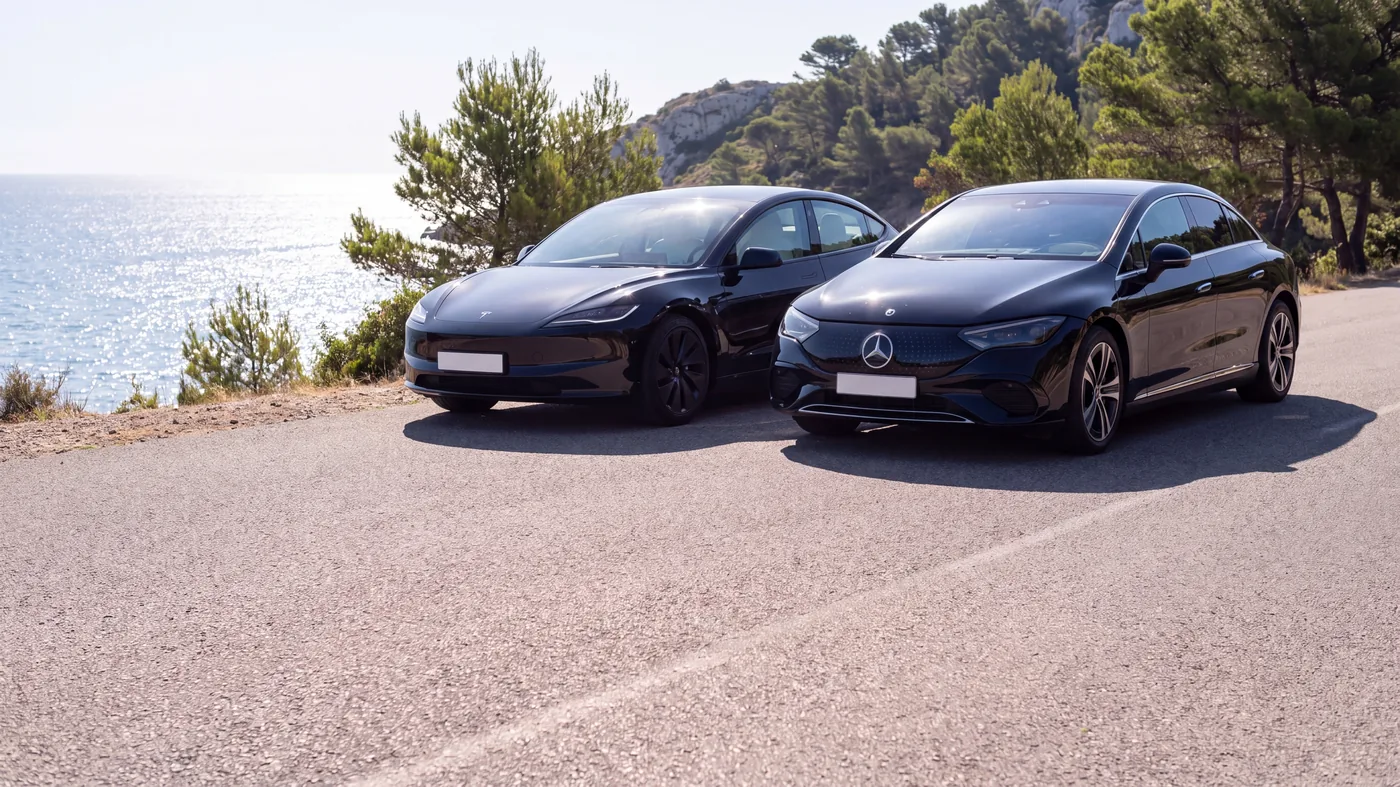
You travel in a saloon, a Tesla Model 3 or Mercedes EQE depending on availability, for up to 4 passengers with 3 suitcases, or in a Mercedes V-Class people carrier for up to 8 passengers: all the details are on the Our vehicles page. Baby seats on request, WiFi and minibar on board, payment by card, Apple Pay or Google Pay. To book your VTC driver in Narbonne, call +33 6 75 67 98 78 or message us on WhatsApp.